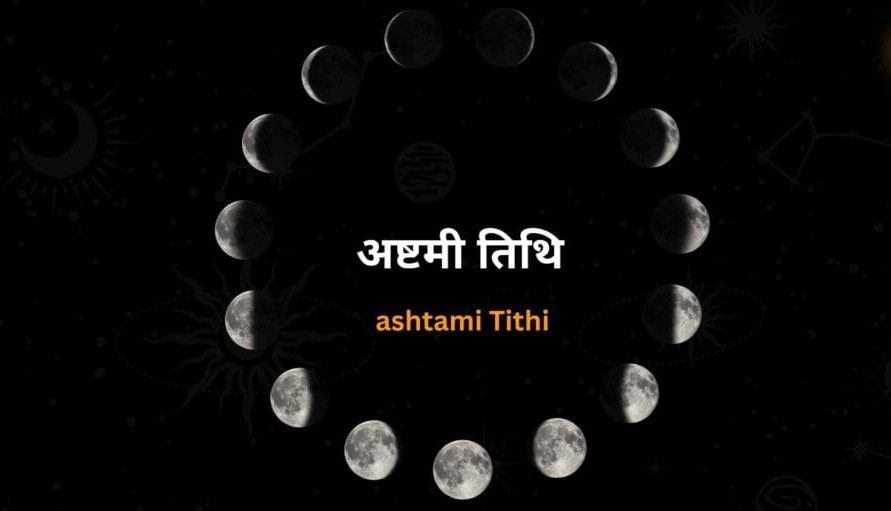
Understanding Ashtami as the Eighth Tithi
Ashtami holds the eighth position in each fortnight of the 30-tithi Hindu lunar month, appearing once during Shukla Paksha, the bright half, and once during Krishna Paksha, the dark half. Positioned almost exactly midway through each fortnight, Ashtami sits at a point where the Moon is either roughly half-illuminated and growing (in Shukla Paksha) or half-illuminated and shrinking (in Krishna Paksha), a phase that traditional Hindu astronomy treats as particularly significant.
Because tithi length is variable, tied to the actual angular movement of the Moon relative to the Sun rather than a fixed 24-hour block, Ashtami’s duration typically ranges between about 19 and 26 hours, and its precise start and end time must be checked through a location-specific panchang rather than assumed to align neatly with a single calendar date.
Durga Ashtami: One of the Most Significant Occurrences
Among all the Ashtami occurrences through the year, Durga Ashtami, falling on the eighth day of Shardiya Navratri, stands out as one of the most widely observed. This particular Ashtami is closely tied to Mahagauri, one of the nine forms of Goddess Durga worshipped during Navratri, and is often marked by Kanya Pujan, where young girls are honoured as living representations of the goddess.
Durga Ashtami also connects directly to Sandhi Puja, a precisely timed ritual performed at the exact transitional moment between Ashtami and the following Navami tithi, considered one of the most powerful moments of the entire Navratri festival according to traditional belief, requiring accurate tithi timing down to the minute for correct observance.
Krishna Janmashtami: Ashtami’s Most Famous Occurrence
Krishna Janmashtami, the celebrated birth anniversary of Lord Krishna, is observed specifically on the Ashtami tithi of Krishna Paksha in the Bhadrapada month, making it arguably the single most widely recognised Ashtami occurrence across the entire Hindu calendar year. The festival is marked by fasting through the day, midnight prayers marking Krishna’s traditional birth hour, and elaborate temple celebrations across India and among Hindu communities worldwide.
Because Krishna Janmashtami is tied so precisely to a specific tithi, occasional differences arise between Vaishnava and Smarta traditions regarding which day is considered correct, based on differing sunrise-based interpretation rules, a well-documented distinction that most panchang sources clearly note for this particular festival each year.
Masik Durgashtami: A Monthly Observance
Beyond the major festival occurrences, many devotees observe Masik Durgashtami every month, treating each Krishna Paksha Ashtami as an opportunity for fasting and devotion to Goddess Durga, entirely separate from the larger annual Navratri celebration. This recurring monthly practice follows the exact same tithi logic as any other Ashtami calculation, simply repeating twelve times a year rather than being tied to a single festival window.
For those who follow this monthly observance, keeping a running list of upcoming Ashtami dates, checked once against a reliable panchang at the start of the year, tends to be far more practical than searching for each individual date fresh every month.
How Ashtami Compares to Neighbouring Tithis
Ashtami sits between Saptami (the seventh tithi) and Navami (the ninth tithi) in the standard lunar sequence, and this positioning matters for several rituals that specifically span these adjacent tithis. Sandhi Puja, mentioned earlier, is a direct example, but several other regional and sect-specific customs also reference the Saptami-Ashtami-Navami window as a spiritually significant stretch within the fortnight rather than treating Ashtami as an entirely isolated observance.
Understanding this positioning also helps explain why panchang listings for Ashtami often show two adjacent tithi names on the same calendar date, since Ashtami’s end-time frequently falls in the middle of a day, transitioning into Navami before midnight.
Frequently Asked Questions
How many times does Ashtami occur in a year? Ashtami occurs twice a month, once in each paksha, adding up to roughly 24 occurrences a year, with occasional additional occurrences in years containing an Adhik Maas, or intercalary lunar month.
Is Ashtami always considered auspicious? Not universally — like most tithis, its recommendations depend on the specific activity being planned, and while it holds strong religious significance for fasting and worship, it isn’t automatically treated as favourable for every category of activity, such as certain types of travel or new ventures, in traditional muhurat guidance.
Can the exact date of Janmashtami or Durga Ashtami shift by a day between sources? Yes, occasionally, due to differing sunrise-based calculation conventions between traditions, which is why checking a specific, well-established panchang source close to the date is recommended for these two occurrences in particular.
Final Thoughts on Ashtami Tithi
Ashtami tithi carries genuine weight across the Hindu calendar, from its role in Durga Ashtami and Sandhi Puja during Navratri to its central place in Krishna Janmashtami and the recurring monthly practice of Masik Durgashtami. Because it occurs twice every month and its exact timing shifts each occurrence, checking a reliable, location-specific panchang remains the most dependable way to plan any Ashtami-related observance accurately, particularly for time-sensitive rituals tied to its precise start and end.
Ashtami’s Role in Kalashtami and Other Sect-Specific Observances
Beyond Durga Ashtami and Janmashtami, certain Ashtami occurrences carry significance for specific sects and traditions. Kalashtami, observed on the Krishna Paksha Ashtami of most lunar months, is dedicated to Lord Kaal Bhairav, a fierce form of Lord Shiva, and is followed by devotees in Shaivite and Tantric traditions with fasting and specific temple visits, particularly in North India.
Similarly, some Jain communities observe their own Ashtami-related fasting days, following a parallel but distinct calculation tradition, illustrating how the same basic tithi structure gets adapted with different religious meaning across India’s diverse spiritual landscape, even while the underlying astronomical calculation of the tithi itself remains consistent.
Whichever specific occurrence brings someone to check Ashtami tithi, whether it’s Janmashtami preparation, Navratri planning, or a routine monthly Durgashtami fast, the same underlying principle applies: confirm the exact timing against a location-specific panchang rather than assuming it matches a previous year or a neighbouring city’s calculation.
It’s also worth remembering that Ashtami’s significance shifts depending on context, sometimes a routine monthly fasting day, sometimes the centrepiece of a major festival like Navratri or Janmashtami, and recognising which category a given occurrence falls into helps set the right expectations for how elaborately it tends to be observed.
Disclaimer: This article is for general informational and educational purposes only, based on traditional Hindu Panchang conventions. Tithi timings can vary slightly by location and calculation method. Please verify exact dates and muhurats with a qualified astrologer or a trusted local panchang before making religious, travel, or financial decisions.