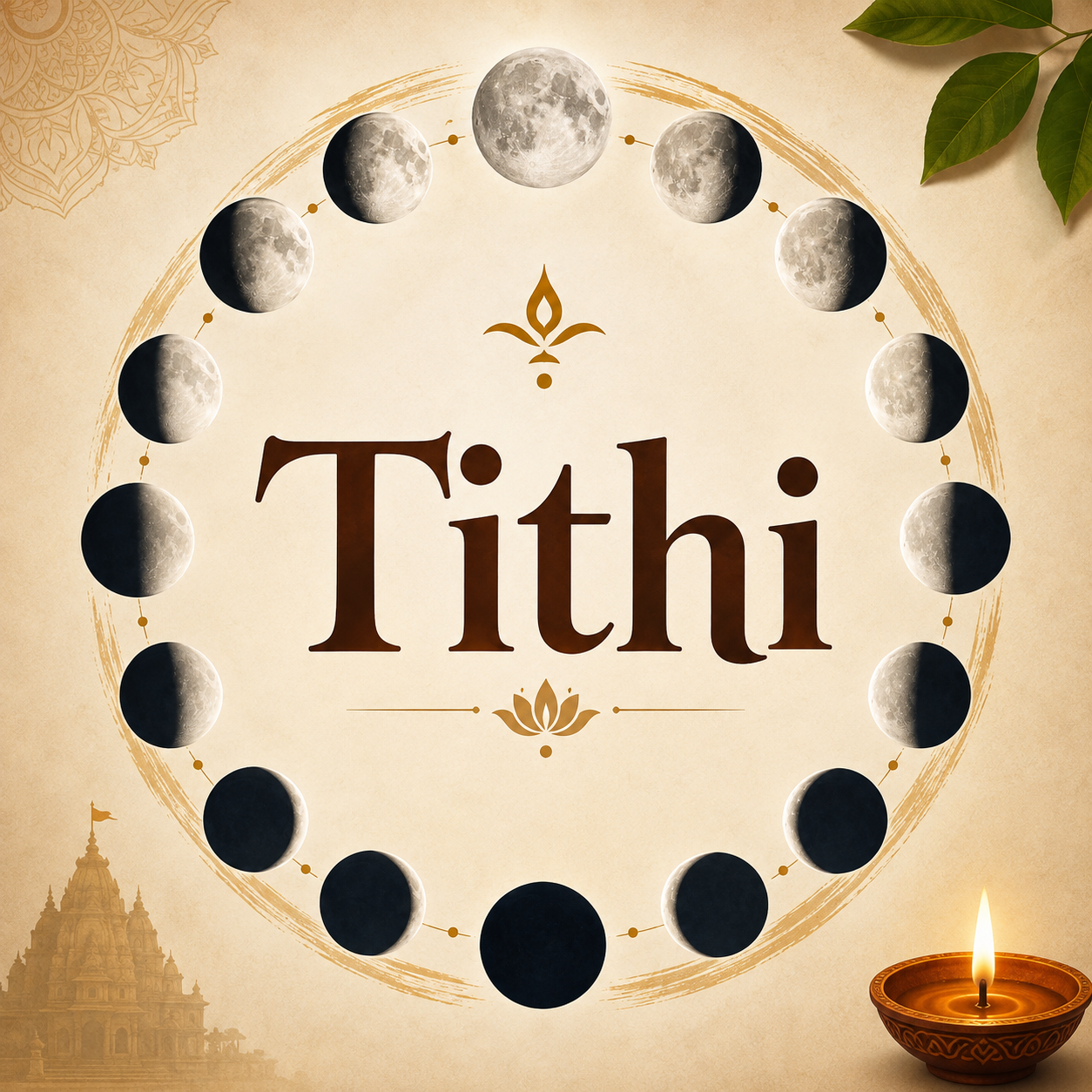
What Is Janm Tithi?
Janm tithi refers to the specific lunar tithi on which a person was born, according to the Hindu panchang, rather than the fixed Gregorian calendar date of their birth. Because tithis shift relative to the solar calendar every year, a person’s janm tithi typically falls on a different Gregorian date annually, sometimes moving by several days, occasionally landing close to the original birth month and sometimes further away depending on how the lunar and solar calendars align that particular year.
In many traditional Hindu households, especially those following older customs, birthdays are marked by janm tithi rather than, or in addition to, the standard Gregorian birthdate, particularly for religious ceremonies and milestone celebrations.
Why Families Track Janm Tithi
Certain important life ceremonies, particularly for children, are traditionally scheduled according to janm tithi rather than the Gregorian calendar. This includes naming ceremonies (Namkaran), first birthday celebrations in some communities, and annual birthday poojas performed by families who follow tithi-based observance for religious milestones.
For adults, some individuals continue observing personal vrats or visiting temples specifically on their janm tithi each year, treating it as a spiritually significant recurring date separate from their standard birthday celebration on the fixed Gregorian date.
How Janm Tithi Is Calculated
To determine someone’s janm tithi, you need their exact birth date, time, and place, since tithi is calculated from the precise angular distance between the Sun and Moon at that specific moment, adjusted for local sunrise. A panchang calculator or an experienced astrologer can convert a Gregorian birthdate into its corresponding tithi, paksha, and lunar month.
Once the original janm tithi is known, finding its recurrence in any future year simply means checking which date that same tithi falls on within the relevant lunar month for that year, which is exactly why the celebration date shifts annually on the Gregorian calendar.
Janm Tithi vs Birth Nakshatra
It’s worth noting that janm tithi is different from birth nakshatra, another commonly referenced birth detail in Hindu astrology. While tithi is based on the Sun-Moon angular distance, nakshatra refers to which of the 27 lunar constellations the Moon was positioned in at the time of birth. Both details are part of a person’s broader birth chart but serve different purposes; nakshatra is often used for naming conventions and personality-related astrology, while janm tithi is more commonly used for scheduling annual religious observances.
Some families track both details together, especially when planning significant ceremonies that traditionally require checking multiple auspicious factors rather than tithi alone.
A Meaningful Tradition Worth Preserving
Whether observed strictly or simply acknowledged alongside a standard birthday, janm tithi remains a meaningful thread connecting individuals to the broader rhythm of the Hindu lunar calendar. For anyone curious about their own janm tithi, checking with family elders for the original birth details, or consulting a panchang calculator with accurate birth information, is the most reliable way to find it.
Frequently Asked Questions
Can janm tithi be calculated without knowing the exact birth time? Approximate tithi can sometimes be estimated from just the birth date, but since tithi transitions happen at specific clock times, having the birth time greatly improves accuracy, especially if the birth occurred close to a tithi changeover.
Do all Hindu communities celebrate birthdays by janm tithi? Not universally — practices vary widely by region, community, and family tradition, with some households celebrating exclusively by the Gregorian date, others exclusively by janm tithi, and many blending both, marking the Gregorian birthday socially while still observing a small pooja on the janm tithi.
A Note for Parents Tracking a Child’s Janm Tithi
For parents specifically wanting to track a newborn’s janm tithi for future annual observances, it helps to note the exact birth date, time, and city immediately, since this information becomes harder to recalculate precisely later on. Many families ask the attending doctor or hospital for the exact birth time specifically for this purpose.
Once recorded, a panchang calculator or knowledgeable family priest can convert this into the corresponding tithi, and from there, checking a yearly panchang each year going forward makes it simple to identify when the child’s janm tithi falls on the Gregorian calendar for that particular year.
It’s worth mentioning that janm tithi calculations can occasionally be affected by tithi kshaya or tithi vriddhi situations near the actual birth date, where a tithi is either skipped or repeated across two sunrises. In such rare cases, a knowledgeable astrologer or priest familiar with traditional panchang rules can help determine the correct observance tithi rather than relying on a simple calculator alone.
With that information recorded properly once, tracking janm tithi becomes a simple annual check rather than a repeated calculation, making it easy to continue the tradition for as many years as the family chooses to observe it.
This kind of careful record-keeping, done once, pays off for years, since it removes any future guesswork about the exact tithi a family member was born on.