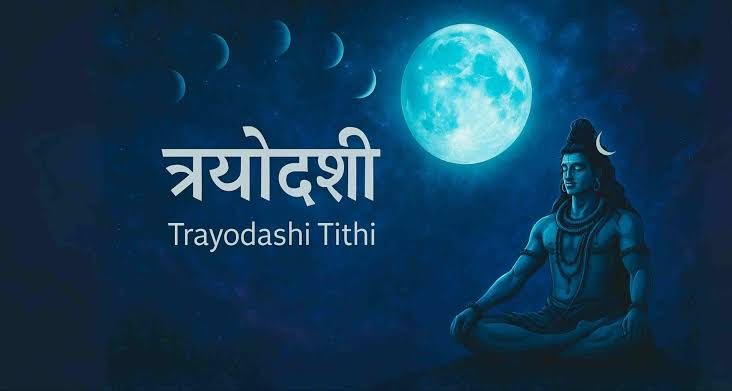
What Is Trayodashi Tithi?
Trayodashi is the thirteenth lunar day (tithi) in the Hindu Panchang, and unlike festivals tied to a single annual date, it occurs twice every lunar month — once during Shukla Paksha (the waxing/bright fortnight) and once during Krishna Paksha (the waning/dark fortnight). This means 2026, like most years, sees roughly 24 to 25 Trayodashi occurrences spread across the calendar, since 2026 includes an additional lunar month (Adhik Maas) in some calculations.
The First Trayodashi Dates of 2026
The year opens with Shukla Paksha Trayodashi on Thursday, January 1, 2026, with the tithi active from 1:48 AM to 10:22 PM that day. This is followed by Krishna Paksha Trayodashi on Friday, January 16, 2026, with the tithi beginning at 8:17 PM on January 15 and continuing into January 16. From there, Trayodashi recurs roughly every 14 to 15 days throughout the year, alternating between the two paksha.
Why Trayodashi Is Significant
Trayodashi is deeply linked with Lord Shiva. When the tithi coincides with sunset, it becomes the sacred Pradosh Vrat — one of the most important bi-monthly fasting observances in Hinduism, dedicated to Lord Shiva and Goddess Parvati. According to tradition, Lord Shiva drank the poison Halahala during the Samudra Manthan (churning of the cosmic ocean) on a Trayodashi tithi, which is how he earned the name Neelkanth (the blue-throated one) — a story central to why this tithi carries such spiritual weight.
Pradosh Vrat: The Main Observance
Pradosh Vrat is observed during Pradosh Kaal — the twilight period beginning at sunset and lasting roughly 144 minutes (about 2 hours 24 minutes) — on every Trayodashi. There are 25 Pradosh Vrat dates across 2026 according to most Panchang calculations. Depending on which day of the week a given Trayodashi falls on, the Pradosh Vrat takes a specific name: Som Pradosh (Monday) and Shani Pradosh (Saturday) are considered especially powerful, while Guru, Budha, Bhauma, Shukra, and Ravi Pradosh mark the other days of the week, each carrying slightly different traditional significance.
Masik Shivratri and Dhanteras
Krishna Paksha Trayodashi carries additional significance as Masik Shivratri — a monthly mini-observance of Shiva worship performed through the night, involving Shiv Abhishek and mantra chanting. The most well-known single Trayodashi of the year is Dhanteras (Dhan Trayodashi), which falls on the Krishna Paksha Trayodashi of the Kartik month and marks the beginning of the five-day Diwali festival — a day considered especially auspicious for buying gold, silver, and new utensils, and traditionally dedicated to Lord Dhanvantari, the deity of Ayurveda.
How to Find a Specific Month’s Trayodashi Dates
Because Trayodashi recurs so frequently and its exact start and end times shift with location, the most reliable way to find the precise Trayodashi and Pradosh Vrat timing for any specific month in 2026 is to check a Panchang tool for your own city close to the date, rather than relying on a generic national list — timings in the tables published by most Panchang sites are typically calculated for New Delhi and need adjustment for other locations.
What the Tithi Represents Spiritually
Beyond its ritual observances, Trayodashi is associated with balance, purification, and the release of past karma. Devotees observing Pradosh Vrat commonly follow a sattvic diet, avoid arguments and borrowing money, and dedicate the evening twilight hours specifically to Shiva worship, reflecting the tithi’s broader symbolic association with equilibrium — balancing duties, desires, and devotion.