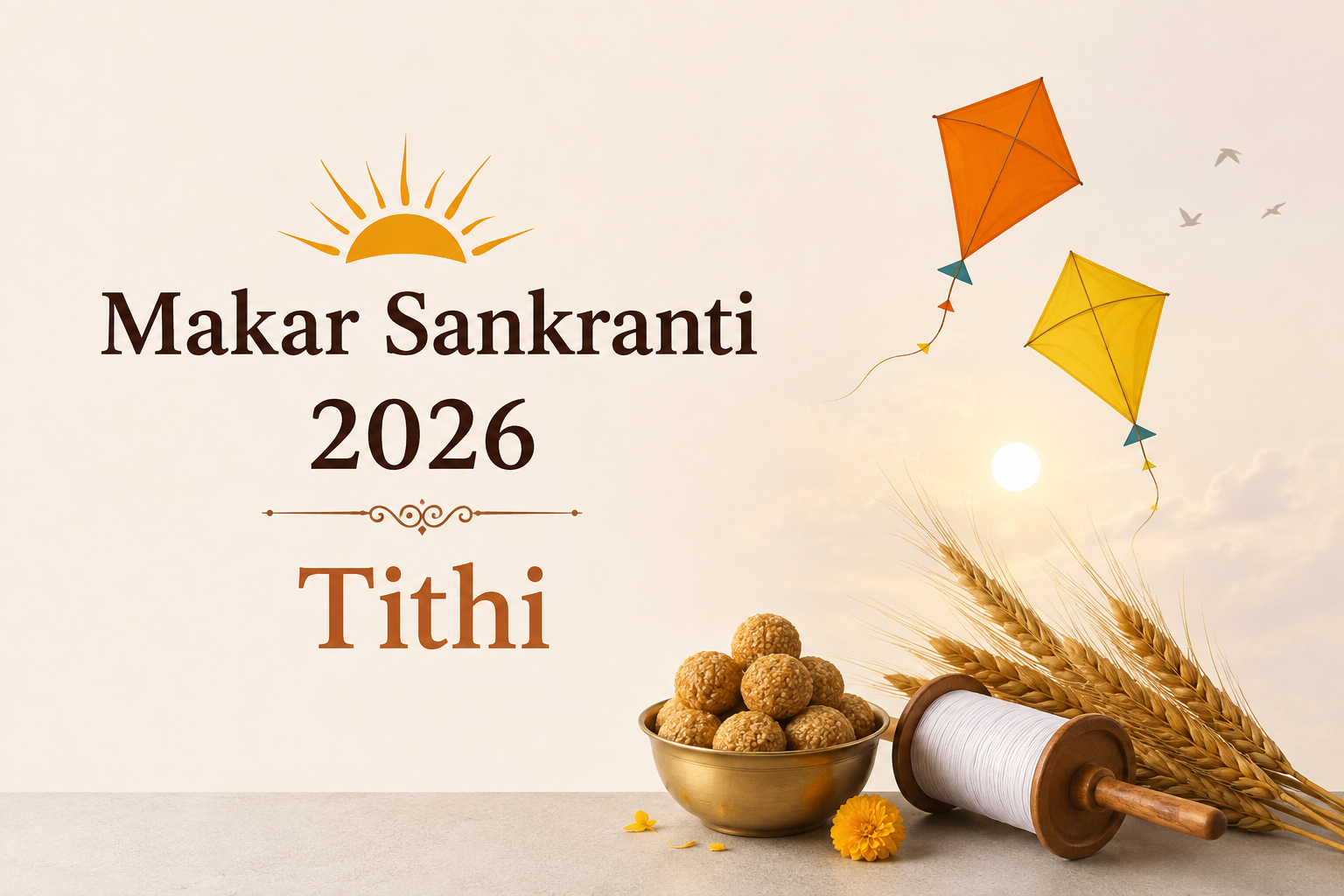
Makar Sankranti 2026: The Key Date
Makar Sankranti in 2026 falls on Wednesday, January 14, marking the moment the Sun transitions into the Makara (Capricorn) zodiac sign, with the exact Sankranti moment occurring in the mid-afternoon that day. This transition signals the end of the winter solstice period and the beginning of Uttarayan, the six-month phase when the Sun’s northward movement is considered especially auspicious in Hindu tradition.
The main rituals of holy bathing (snan) and charity (daan) are traditionally performed on the day of the Sankranti itself, with the most auspicious window, known as Punya Kaal, falling for a few hours after the exact solar transition.
So, Makar Sankranti 2026 Tithi Konsi Hai?
This is where many people get confused: Makar Sankranti does not actually follow a lunar tithi the way most other Hindu festivals do. Unlike Diwali, Holi, or Navratri, which are calculated based on the Moon’s position (tithi), Makar Sankranti is purely a solar event, calculated from the Sun’s movement into a new zodiac sign. This makes it one of the few major Hindu festivals with a fixed date that barely shifts from year to year, typically falling on January 14 or occasionally January 15.
Because of this solar basis, asking specifically which tithi governs Makar Sankranti doesn’t have a single fixed traditional answer the way Ekadashi or Ashtami would. What matters for this festival is the precise sidereal solar transit moment, not the surrounding lunar tithi, even though a tithi is technically still active on that calendar day as part of the ongoing lunar month.
Regional Names and Celebrations
Makar Sankranti is celebrated under different names and customs across India, all tied to the same solar transition. In Tamil Nadu, the festival is observed as Pongal, spanning multiple days from January 13 through January 17, with Thai Pongal as the main day. In Punjab and parts of North India, Lohri is celebrated the evening before, on January 13, with bonfires and folk celebrations marking the close of winter.
In Assam, the equivalent celebration is Magh Bihu (also called Bhogali Bihu), typically observed around January 15, while in Andhra Pradesh and Telangana, the festival extends across several days as Pedda Panduga, including Bhogi, Sankranti, and Kanuma.
Why the Date Stays Nearly Fixed Every Year
Because Makar Sankranti depends on the Sun’s sidereal position rather than the Moon’s phase, its Gregorian date barely moves across years, unlike lunar festivals which can shift by weeks depending on the tithi cycle. This is a key distinguishing feature worth remembering when comparing it to festivals like Navratri or Diwali, whose dates change more noticeably each year based on tithi calculations.
Quick Summary
Makar Sankranti 2026 falls on January 14, and rather than being governed by a specific tithi, it is a solar festival marking the Sun’s entry into Capricorn. While a lunar tithi is technically active on that date as part of the regular monthly cycle, it is the solar transition moment, not the tithi, that defines when and how the festival is observed across India’s many regional traditions.
Frequently Asked Questions
Does Makar Sankranti ever fall on January 15 instead of January 14? Yes, occasionally, depending on the precise moment of the solar transit and calendar leap-year adjustments over time, Makar Sankranti has shifted to January 15 in some years and may continue to do so gradually in future decades, though 2026 falls on January 14.
Why do some other Hindu festivals shift by weeks each year while Makar Sankranti barely moves? This comes down to the underlying calculation method — solar festivals like Makar Sankranti stay nearly fixed on the Gregorian calendar, while lunar tithi-based festivals like Diwali or Navratri shift more noticeably because the lunar year is shorter than the solar year by about eleven days.
How This Differs From Lunar Festivals You May Compare It To
It’s easy to assume Makar Sankranti works the same way as festivals like Diwali or Holi, since all three are widely celebrated across India, but the underlying calculation logic is fundamentally different. Diwali and Holi are tied to specific tithis within specific lunar months, meaning their Gregorian dates shift by roughly 10 to 20 days most years.
Makar Sankranti 2026 tithi konsi hai therefore isn’t really the most useful question to ask when planning for this particular festival; instead, tracking the solar transit date directly, which stays close to January 14 nearly every year, is the more reliable approach for this specific celebration.
For anyone specifically researching makar sankranti 2026 tithi konsi hai for religious planning purposes, the practical takeaway is to focus on the January 14, 2026 solar transit date and its associated Punya Kaal timing window, rather than searching for a governing tithi that, by the festival’s own solar nature, doesn’t apply in the same way it does to lunar festivals.
This distinction between solar and lunar festivals is genuinely one of the more useful things to understand about the Hindu calendar as a whole, and Makar Sankranti remains one of the clearest examples of it in practice.